
History & Heritage of Kamakhya

Artist’s Imagination of Kamakhya Temple
Introduction to Kamakhya’s Sacred Landscape
The land of Kamrup, characterized by its beautiful landscape of hills and wetlands, the mighty river Brahmaputra, rich natural resources, and the lush vegetation has played an important role in the history and evolution of a unique religious tradition and culture that flourished here. In the Guwahati area of this Kamrup, on the Nilachala hills (Kamakhya Hill), peetha of the Devi Kamakhya is located, surrounded by the Mahavidyas, other Goddesses, Pancha Shivas, Mahakala & Dwarpala Ganeshas, Vishnu, other deities, sacred ponds, and numerous sacred sites, scattered all over the hill. This makes the Kamakhya Hill a sacred complex of several temples and hence, use of the phrase Kamakhya Temples’ Complex of Nilachala hills instead of just Kamakhya is more appropriate for a better understanding of the site.
Significance of the Kamakhya Temples’ Complex
Devi Kamakhya in the form of one of the Dasa Mahavidyas is worshipped as Tripura Sundari or Sodasi. Devi Kamakhya is also called bhagavati, who possesses bhaga or the yoni, the creative force and is worshipped in the form of a rock (the peetha) inside a dark cave (the garbhagriha), perpetually wet from a stream of water. The place that is popularly known as Kamakhya, actually is a hill system comprising of three segments (i.e. Brahma, Shiva, and Varaha hill) referred to in the scriptures as Nilachala, is also referred variously as Kamagirii, Mahagiri, Kamakhya Yonimandala, and Kamakuta.
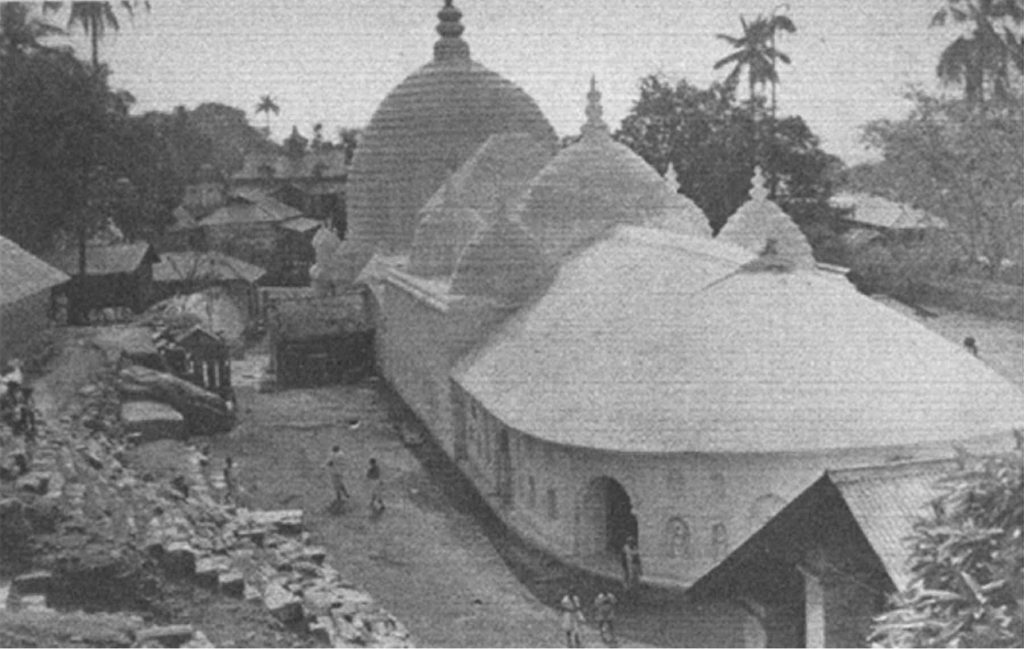
The history of Kamakhya Temples’ Complex is obscure and inter-mixed with inadequate historical records, oral history, mythological texts, legends, folk-lore, etc. till the advent of the Koch Kingdom. The mysticism surrounding the worship of the goddess Kamakhya has also lent a mysterious aura to the whole region and various social norms have sprung up which are quite distinct in comparison to the rest of the country.The countless pieces of sculpted stone that are lying scattered all over the Nilachal hills bear mute testimony to the beauty of the original stone temple of Kamakhya. As per the scriptures, the main temple was covered in stone sculpted images of the Sixty-Four Yoginis and Eighteen Bhairavas. Maybe, owing to disputes, the ravages of time and natural calamities, only the base of the original temple of Kamakhya survived till it was rebuilt in the 16th Century AD.
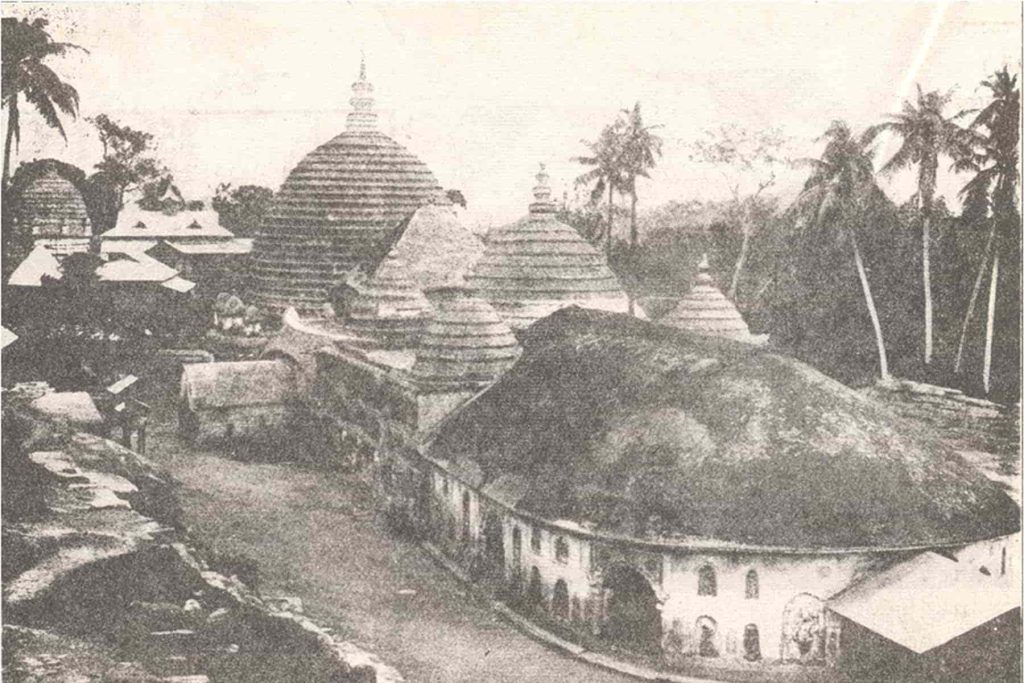
Kamakhya Temple in 1930’s
Historical References of Kamakhya
Naraka and Kamakhya – A Mythological Perspective
Mythologically, Krishna crowned Naraka as the king of Pragjyotisha and also assigned the responsibility of looking after the worship and maintenance of Devi Kamakhya and Nilachala to him.
Historical evidence of the existence of Naraka is a subject of debate because of the fact that information related to him appears only as legends in the scriptures like Harivamsa, Kalika Purana, Yogini Tantra, Mahabharata, Ramayana, etc., while some scholars suggest that the reign of king Naraka could be from 2200-2169 BC. Hence, we may arrive at a cautious conclusion that king Naraka possibly existed and the Kamakhya temple was shining with pride and glory during 2200 BC on the Nilachal Hills.
References in Mahabharata and Pandunath Site
The earliest traceable reference of Kamakhya temple can be found in various sections of the epic Mahabharata (300 BCE-300 CE). In one section of the Mahabharata, it is mentioned that the Pancha-Pandavas, after the years of agyatavas (a period of unidentifiable living during the exile), came to Nilachala, took their ceremonial bath in the river Lauhitya (river Brahmaputra) and worshipped Goddess Kamakhya to regain their lost kingdom.
There is a sacred site named Pandunath located in the north-west direction of the Nilachala hills on the banks of the river Brahmaputra where the Pancha-Pandavas camped during their visit to Kamakhya Temple.Near Pandunath, a site still exists named Pancha-Pandava, which bears the testimony of the visit of the Pandavas.
Archaeological and Scientific Findings on Kamakhya
Umachala Rock Inscription
According to some published documents, the Kamakhya Temple existed on the Kamakhya Hill during 4th-5th Century AD. The analysis of this fact, Umachala Rock of Kamakhya Temples’ Complex Inscription can be taken into consideration. The Umachala Rock Inscription dates back to 5th Century AD and it records that a cave temple was constructed by king Surendraverman.
Based on the analysis of the structural remains of the Kamakhya Temples’ Complex and historical materials, some scholars have suggested that the Kamakhya Temple dates back to 7th-8th Century AD and that some of the temples of the Mahavidyas and Pancha-Shiva date back to 10th-11th Century AD.
Radiocarbon Isotope Test on Kamakhya Temple
The department of Geo-sciences, Gauhati University (Reported by B.P. Duara, 2003) conducted a radio carbon isotope age determination exercise on the Kamakhya temple. The result of this scientific exercise revealed that there are two layers below the floor of the Kamakhya temple. The radio carbon isotope test of the layers shows that, the bottom layer is 2200 years old and the second layer is 1500 years old.
This scientific experiment provides significant evidence that the Kamakhya temple is more than 2200 years old. Thus, based on the outcome of this scientific exercise, it can be accepted that a temple stood on this site as early as 200 BC, and an attempt was made to rebuild or renovate the temples’ complex around the 5th Century AD.
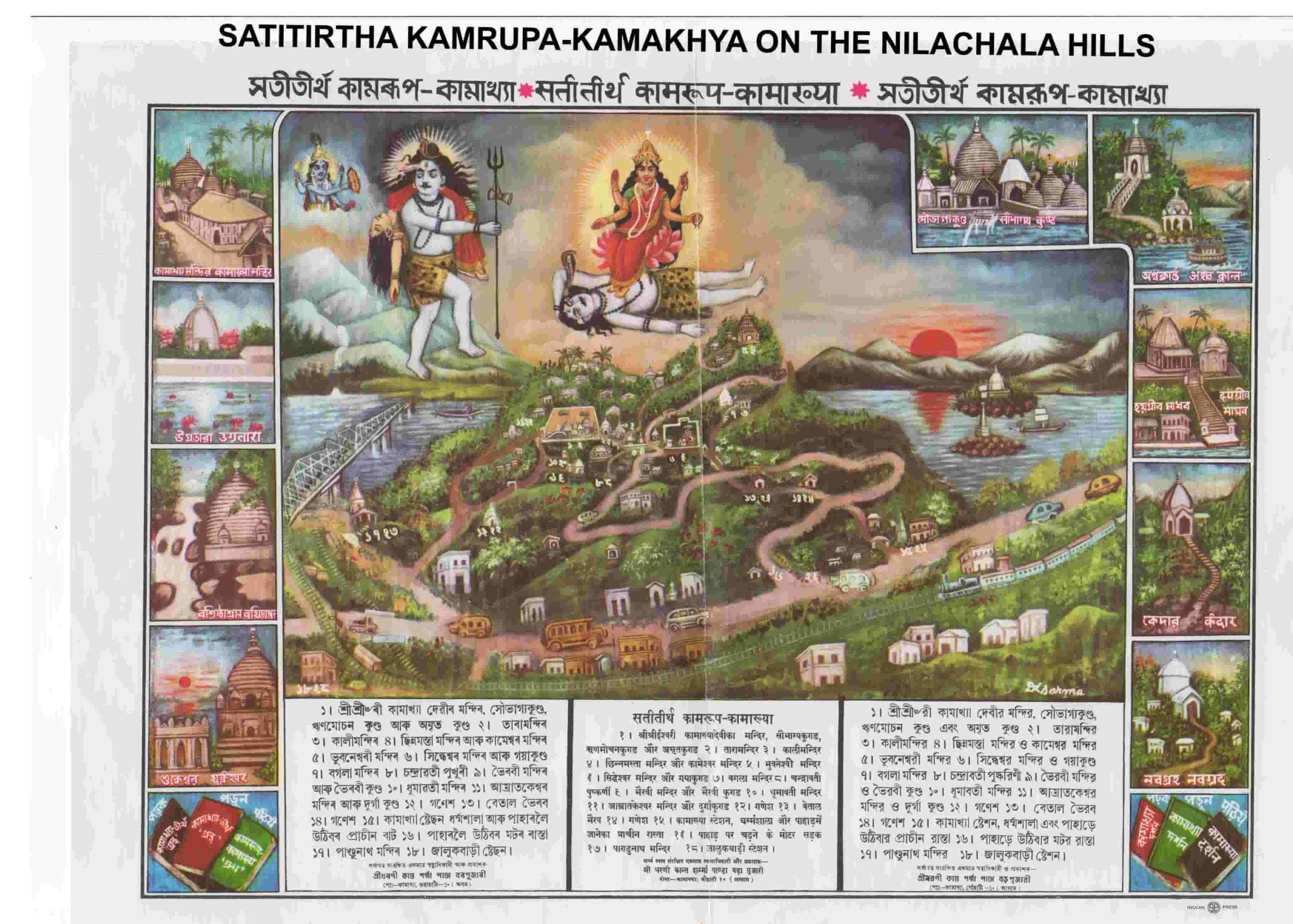
Artist’s Imagination of Kamakhya Temples, Complex
Rebuilding of Kamakhya Temple in the Koch Dynasty
Reconstruction by King Biswasingha and Naranarayana
As per historical information available from some published documents, Biswasingha (1515–1540 AD), the first king of the Koch dynasty, re-built the upper part of the original temple at Kamakhya. After re-building the temple by Koch king Biswasingha, as per a narrative, in 1553 AD, the temple was destroyed by the invading Muslim commander Kalapahar in his crusade against Hindu temples.
The upper part of the temple remained dismantled till mid-16th Century AD. King Naranarayana (1540–1587 A.D.) of the Koch dynasty started rebuilding the present temple in 1555 AD and completed it in 1565 AD. King Naranarayana engaged architect Meghamukdam and as per available information, he tried to rebuild the dome twice with the original stone blocks, but failed. Finally, Meghamukdam built the dome in the shape of a beehive with bricks. Under the rule of the Ahom dynasty during the 17th-19th century AD, the Kamakhya temple and surrounding temples’ complex expanded and flourished, with a considerable number of temples re-built, constructed, and renovated for the Mahavidyas, various forms of Shiva, Ganesha, and other deities during this period.
Religio-Social Perspective of Kamakhya Temples’ Complex
Evolution of a Unique Religious Culture
The Kamakhya Temples’ Complex is one of the world’s most important sites of goddess worship. As a pilgrimage center for Hindus, Buddhists, and practitioners of various streams of Tantrism from time immemorial, a uniquely syncretic religious culture has developed in the Kamakhya Temples’ Complex. The rituals and festivals celebrated at the Kamakhya Temples’ Complex are distinctive and unique and are the result of hundreds of years of socio-cultural and religious evolution, assimilation, and syncretism. The current tradition, with the systems of homa (oblations), puja (worship), kriya (rituals), bali (sacrifice), and associating of natural elements represents a complex negotiation between orthodox and heterodox systems and the practices are held in balance by the Sevaits (servitors), the ancestral community that resides at and serves the temples of the Kamakhya Temples’ Complex.
Rituals and Festivals at Kamakhya
The daily religious and ritualistic schedule of the temples of the Kamakhya Temples’ Complex starts early in the morning and ends in the evening. The system of Puja / Ritual is exclusive to temples of the Kamakhya Temples’ Complex. The essence of the religious and ritualistic system and tradition of the Kamakhya Temples’ Complex is its practical approach and rhythmic style of the Puja / Ritual dominated by the Kulachara Tantra Marga (a tradition within the Vamacara Tantra Marga).
The unique system of worship, rituals, and festivals of the Kamakhya Temples’ Complex have evolved, developed, and taken shape since a very ancient period, which is difficult to determine. Rooted in the rich history of yoginis, siddhas, saints, and kings, the socio-religious system and traditions have been maintained within the familial, ritualistic, and initiatory lineages of the Sebaits for many centuries. The process still continues through careful and consistent maintenance, constant research, and practical application of the elements of the tradition, much of which is necessarily kept secret to maintain its sacrality and power.
The socio-religious systems and related traditions of the Kamakhya Temples’ Complex are by nature very tolerant and secular. All devotees, irrespective of caste, creed, belief, nationality, ethnicity, gender, or religious affiliation, are allowed to enter the sanctum sanctorum of all the temples of the Kamakhya Temples’ Complex for darshan and worship. All devotees are encouraged to touch the Peethas of the temples and offer their prayers.
Get in Touch with Us
For more information, direct assistance, guidance, and other services for visiting Kamakhya Temples Complex and the greater region of Kamrup.