
Shebaits of Kamakhya Temples’ Complex
Role of Shebaits in Kamakhya

The most important aspect of Kamakhya Temples Complex is the tradition of the Sebaits (servitors) who are an inseparable part of the ritualistic, socio-religious, and socio-cultural tradition of the Kamakhya Temples Complex. There are clear historical evidences available that the ruling dynasties of Pragjyotishpura, Kamarupa, and the Ahom Kings, who worshipped and patronized Kamakhya, brought selected persons from various parts of India to serve and take part in the elaborate religious, ritualistic, and ceremonial duties of the Kamakhya Temples Complex. All the Sebaits offer their sincere and dedicated services towards the proper management of the religious tradition (worship/ritual/festivals) as well as other affairs related to the management of Kamakhya Temples Complex since they were brought here.
The system of distribution of duties/services/responsibilities of the Sebaits is called Pali or Pala, which rotates within the families of a particular group of Sebaits based on their duty and responsibility. According to the system, a particular family of a particular group of Sebaits offers their services for a particular day or duration and then vacates in favour of another family of the same group of Sebaits. This rotation system has been documented as per the Hindu calendar and the same is being followed since time immemorial.
Diksha and Guru-Shishya Parampara
To actually become eligible as a Shebait to participate in the worship/ritual/festivals of Kamakhya Temples Complex, the male member(s) of a family of some Shebait groups have to go through the process of Diksha (initiation) under the Guru. The Guru-Shishya Parampara (tradition) is an inseparable part of the system and tradition of Kamakhya Temples Complex and without Diksha (initiation) major groups of Sebaits are not allowed to offer religious and ritualistic services in any temples of the Kamakhya Temples Complex. Though the initiation is the primary criterion for qualification of a Shebait to actually become a part of the religious and ritualistic system and tradition of the Kamakhya Temples Complex, there are some Shebait groups who do not necessarily have to be initiated to offer their services Role of Women Members of Sebaits Families at Kamakhya
Role of Women in Shebait Families
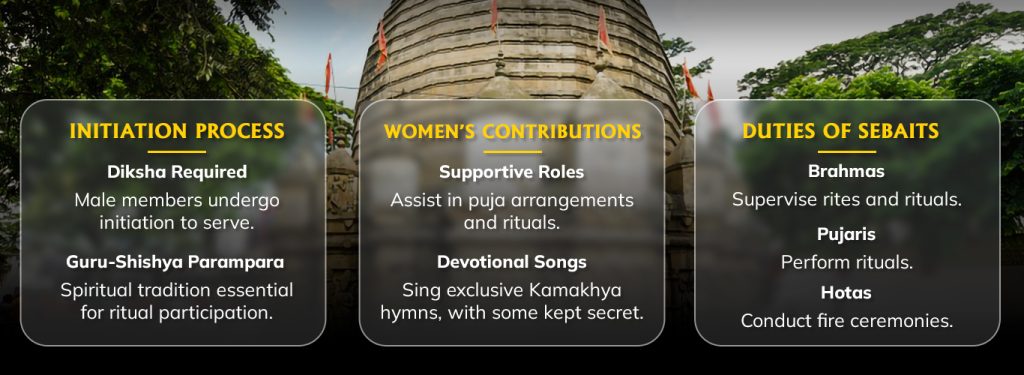
As per the tradition, only the male members of the Shebait families are rendering services in the Kamakhya Temples’ Complex. Though only male members are directly involved, the women of the Shebait families also play an important role in the tradition of Kamakhya. The women render help in the necessary arrangement for the puja / ritual / festival / ceremonies at the household level, and on some occasions in the temples.
The most important part that women play during the puja / rituals / festivals / ceremonies is that a group of women sing devotional songs / hymns / prayers which have evolved at Kamakhya and are exclusive to Kamakhya. The lyrics of some of these songs / hymns / prayers are guarded as secrets and are not disclosed or shared with those who are not part of Kamakhya.
The Raja-Rajeswari Puja performed during Chaitra Navaratra (Spring Navaratra) for 15 days is the principal puja / ritual of the initiated Male and Female Sebaits of Kamakhya under the Kulachara Tantra Marga of Kamakhya. In the puja / rituals, the initiated Male and Female Sebaits of Kamakhya participate together. The puja / rituals of the Raja-Rajeshwari Puja are performed behind closed doors, and non-initiates are strictly not allowed to participate, even if they are Sebaits of Kamakhya.
Different families of Sebaits were brought to the Kamakhya Temples’ Complex by the erstwhile kings at different periods of time to serve in the temples for the performance of the various rites, rituals, festivals, ceremonies, and duties. As per the tenets laid down in the scriptures, the system of worship is an elaborate affair requiring the participation of several different classes of priests designated as…
1. Brahmas, well versed in the Vedas, Purans and Samhitas for the supervision of the rites and rituals to be conducted and for taking Sankalpa for the puja and rituals;
2. Pujaris or Pujaks for the performance of the rites and ritualistic practices i.e., the puja and rituals;
3. Bidhipathaks for the reading out the “Bidhi” (scriptures and instructions) to guide the pujaris in the observance of the rules of such puja & rituals and the recitation of the mantras;
4. Hotas for the performance of the “Homa” (ritualistic Fire) or the rites associated with the fire altar; and
5. Chandipathaks for performing the puja, rituals and chanting the “Chandi” (Durga Saptasati) related to the invocation of the Goddesses;
The duties related to the preparation of the daily offering of “Bhog” (cooked offerings) is entrusted to Brahmin families called the “Supakars”.
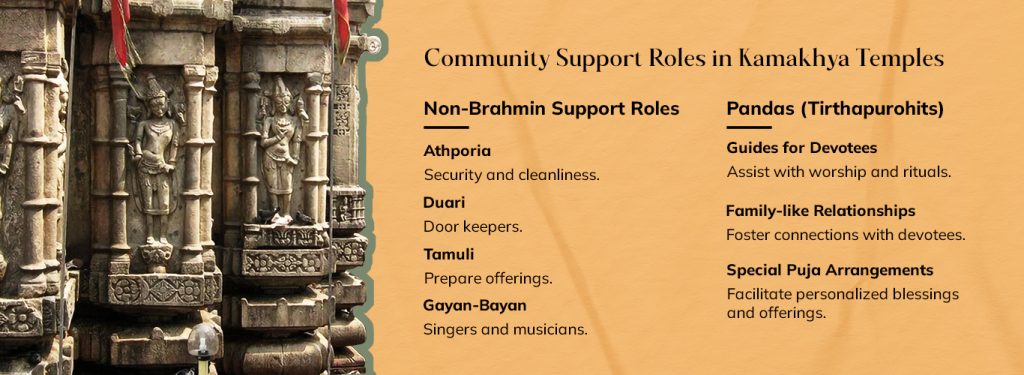
Apart from the Brahmins a host of non-brahmin Shebait families formed the majority of the workers and servants of the deity. These families were directly responsible for the smooth functioning of the entire process of worship and are part and parcel of the ritualistic practices. Here also the different categories of duties led to the creation of distinct groups and were named as,
1. Athporia or Astha Prahari, the keepers of security and supervisors of cleanliness inside the temple
2. Duari, the door keepers
3. Bolikata, the persons involved in the sacrifice of the offered animals
3. Bolidhara, the persons assisting the Bolikata in the sacrifice
4. Tamuli, the arrangers of the Naivedyas or offerings
5. Bhandar or Bhandar Kayastha, the supplier of the raw materials of the Bhog and Naivedyas.
6. Bharali, the store keeper
7. Mali, the supplier of flowers and fruits
8. Malakar, the makers of the garlands
9. Paneri, the water supplier
10. Gayan-Bayan, the singers and musicians
11. Seel, the barbers
12. Jagamukti, the cleaner of the sacrificial alters
13. Sonari, the goldsmiths and silversmiths
14. Da Dhara, the persons who sharpens the sacrificial swords
15. Kaur Khenia, the persons who drive away birds and animals from the temple premises
16. Shitenia, the persons who assist the Supakars in the preparation of the Bhog (cooked offerings)
17. Danda Dhara, the persons who hold the flags and poles in the procession of the Devi Kamakhya and other deities during festivals and ceremonies
Get in Touch with Us
For more information, direct assistance, guidance, and other services for visiting Kamakhya Temples Complex and the greater region of Kamrup.